
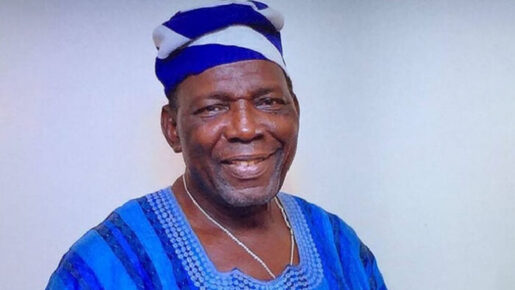
It says a whole lot about Nigerians that Chief Festus Adegboye Onigbinde is mostly remembered for his period with the Super Eagles at the 2002 FIFA World Cup in the Far East. It is also an indictment on a people who hate or refuse to acknowledge their own history in every sphere of life.
For many of my generation who love and have followed the Nigeria senior men’s national team, Chief Onigbinde would always have a special place in our hearts. I have nothing but the warmest thoughts of the man. He was a great man, as far as I and my peers are concerned. A proud man. A very intelligent man. Well-spoken and very articulate whenever you are in his presence.
After winning in the AFCON on home soil in 1980, the very next competitive game was the 1982 FIFA World Cup qualifier away in Tunisia. It was horrible to watch. The 2-0 defeat flattered the visitors as it could have been anything north of that scoreline. Fortunately, the second-leg was in Lagos. It was an almighty struggle but a late Emmanuel Osigwe magic levelled the match on aggregate and took it to penalties where Best Ogedegbe in goal saved one kick and managed to convert his to take Nigeria through to the next round.
Before that next round, Nigeria got drafted to the Moscow ’80 Olympic Games as African Champions. Two defeats – to Kuwait and Colombia were sandwiched by a draw against eventual gold medallists, Czechoslovakia.
The World Cup qualifiers resumed where we managed to get past Tanzania after drawing in Lagos with a shock win in Dodoma in the 2nd-leg. Guinea beat Nigeria 2-1 in Conakry in the next round but a late, late Henry Nwosu strike in Lagos put Nigeria through on away-goals rule.
After all those near-misses, we arrived at playing Algeria in the final qualifier for that World Cup. The Algeria of Assad Sallah, Lakhdar Belloumi, Ali Fergani et al served us up on a carving plate with a comprehensive 4-1 aggregate defeat. It had been coming. It had to happen.
A few months later Nigeria staggered into Libya to try and defend the trophy won so thrillingly in Lagos two years earlier. To this day, there are conflicting reports on who coached the team at the competition. Uncle Fabio Lanipekun told me that the NFA at the time asked the coach of then amateur league side, Julius Berger, to take the national team and African Champions to Col Gaddafi’s country.
A first match win over Ethiopia promised a false dawn. Algeria and finally, Zambia pulled down the curtains on the idea of a dawn. As shambolic a title defence as you would likely see. Coming from the future, it was to become a feature of Nigerian football, not a bug.
It was after all these defeats that Onigbinde arrived on the scene to coach the Green Eagles. He was fortunate to have arrived at a time that Willy Bazuaye was doing great things with the players at his disposal at New Nigeria Bank of Benin. In the same period, Chris Udemezue had assembled a bunch of young players who were able to qualify Nigeria for the U20 (then WYC) World Cup in Mexico.
As a very intelligent man, Onigbinde went about building a new Green Eagles with a combination of players from these teams. Nigerians started enjoying more victories than defeats. AFCON 80 winners, Muda Lawal and Henry Nwosu were joined by Stephen Keshi and Ademola Adeshina from the 1982 AFCON debacle.
The first real signs of progress was the 1984 Olympic qualifier against neighbours and fierce rivals Ghana. A needless, ultimately worthless Shagari ECOWAS Cup for the U19s taking place in Lagos forced the first leg of the qualifier to be played in Kaduna. A goalless draw against the African Champions made every Nigeria fear the worst for the second-leg.
At a packed Kumasi stadium for the return, Chibuzor Ehilegbu and Opoku Nti exchanged goals and as the match moved towards the end, Monday Eguavoen scored the winner with only two minutes left. Nigeria had won in Ghana in a competitive match since Independence. The tough matches came thick and fast in 1983. A Nations Cup qualifier pitched Nigeria against Morocco.
Another goalless draw in Nigeria meant a fraught away trip beckoned. It was goalless in Rabat also but in the penalty shoot-out, keeper Peter Rufai proved the hero as Nigeria qualified for the 1984 AFCON. The two countries met again, this time in a final Olympic qualifier. Another goalless first leg in Nigeria and a trip to Casablanca for the second leg.
It was in this match that Onigbinde showed his man-management. On the eve of the match in Morocco, Rufai “came to me and said he was not in a fit state to play the match,” was to say to me many years later. “I called Keshi and we went to speak to him but he insisted he was not going to play. We left his room and Keshi asked me what was going to happen. I told him that Patrick Okala would play. But we were not going to tell him until when we are on the bus to the stadium. It was important not to give him too much time to ponder on the assignment so he won’t be nervous.”
Okala was duly informed on the bus to the stadium. The Rangers International keeper had a very good match and helped Nigeria keep Morocco at bay and the game into penalties just like a few months ago when Nigeria last visited. In the shoot-out, he saved one kick but Nigeria still lost and missed out on the LA Games.
At AFCON ’84 proper, victory over Ghana again followed by draws with Malawi and Algeria ensured passage to the semi-final. The Egypt of Abou Zeid and Ibrahim Youssef were favourites and they went 2-0 up in the first half. Keshi pulled a goal back just before half-time. Bala Ali came through with a late equaliser to send the game into extra time and eventually penalties. Rufai’s heroics and Muda Lawal’s pen sent Nigeria to a first AFCON final on foreign soil. A remarkable improvement from the shambles of two years earlier.
What Onigbinde showed with the team at that AFCON was a coherent strategy that allowed Nwosu and Ehilegbu to start together, Adeshina holding. Humphrey Edobor, the swashbuckling left-winger of the 1983 Flying Eagles was pulled inside to offer cover so that those two attacking midfielders could have the room to play.
Unfortunately for Onigbinde, in winning the penalty that led to Nigeria’s first goal in the semi, Ehilegbu was injured. “My achilles heel was badly injured by the defender when he stepped on me” Ehilegbu said to me over the phone many years after. “The day before the final, the technical crew tried everything to get me fit for the final. It was too swollen and the swelling never came down. It was only a few hours to the match that it was decided that I was not going to play.”
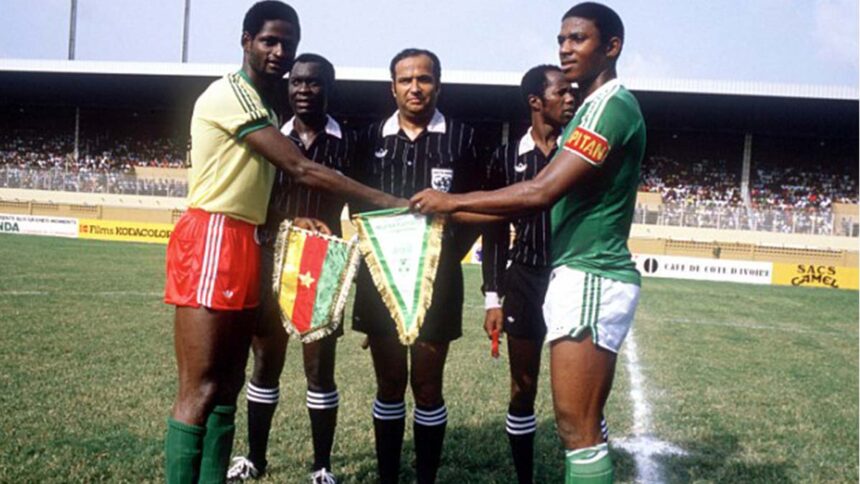
Again, Onigbinde pivoted. James Etokebe, the powerful running Calabar Rovers left winger was drafted in from the start. Edobor moved well inside into the number 10 role. Etokebe’s cross caused the mayhem that led to Lawal giving Nigeria the lead against Cameroon.
The Cameroonians recovered to win 3-1 and claim their first AFCON triumph. However, Onigbinde had restored Nigerians’ faith in the senior men’s national team inside the about twenty-four months he was in charge.
His legacy of Rufai, Keshi and Yekini at that AFCON stayed with Nigeria for a decade and into an AFCON win and a first FIFA World Cup appearance all in 1994.