
Success rarely announces itself in the moment. More often, it disguises itself as disappointment, frustration, and lessons learned the hard way. In life—as in football—we grow not when everything goes right, but when we are forced to respond to what goes wrong.
Simon Sinek, the American author and leadership expert, captured this truth succinctly when he wrote: “We don’t learn much when things go right. It is when things go wrong that we learn the most.” I couldn’t agree more. That insight applies not only to leadership, but to life itself—and to every field of human endeavour.
I often see striking parallels between life and sport, particularly team sports. There is something deeply instructive about watching a group of individuals work toward a shared goal, navigating success, failure, pressure, and renewal. Football, in particular, mirrors life in ways that are impossible to ignore.
I have been a lifelong Arsenal supporter—a Gooner through and through—for 36 years. In that time, I’ve experienced unforgettable highs and crushing lows. Glorious triumphs and painful heartbreaks. Much like life, football teaches you to put moments into perspective, learn from them, and keep moving forward.
That is why the quote from Simon Sinek resonates so strongly with me—and why it captures what I admire most about Mikel Arteta.
Arteta first arrived at Arsenal as a player during a turbulent period for the club—deadline day in 2011 comes to mind. Years later, in 2019, he returned as manager at arguably Arsenal’s lowest ebb. What followed has been a journey of growth—not just for the club, but for Arteta himself.
With the backing of the Kroenke family, the dedication of his backroom staff, and the collective effort of everyone at the club, Arteta has overseen a cultural and competitive transformation. Arsenal are no longer drifting; they are once again a force to be reckoned with.
The heartbreak of the last three Premier League seasons—coming agonisingly close—has been difficult to bear. Yet I watched Arteta navigate those moments while learning on the job, managing an injury-hit squad, and competing against relentless teams like Manchester City and Liverpool. Those seasons, painful as they were, became lessons.
On May 19, 2024, after our 2–1 win against Everton on the final day of the season, I was one of nearly 60,000 fans who stayed behind at the Emirates. Though gutted at missing out on the title, we remained to thank the team. I watched an emotional Mikel Arteta take the microphone. The pain in his voice was unmistakable as the stadium echoed with:
🎶 We’ve got Super Mik Arteta 🎶
His final message to us that day still rings in my ears:
“Keep pushing, keep inspiring this team. Don’t be satisfied, because we want much more than that—and we are going to get it.”
As I left the stadium, disappointed but reflective, I tried to imagine what he must have been feeling. I knew then that the pain would fuel him—that he would do everything within his power to bring titles back to Arsenal.
Last season’s injury crisis was another learning curve—for Arteta, his staff, and the owners. The club’s subsequent recruitment strategy showed a willingness to “fail forward,” to borrow a phrase from leadership expert John Maxwell. Arsenal learned, adapted, and improved.
Midway through the 2025/26 season, Arsenal sit top of the Premier League with 45 points (14 wins, 3 draws, 2 losses), lead their Champions League group, and have reached the Carabao Cup semi-finals. While no titles are won in December, the manner of these performances has been impressive—especially considering injuries and the sense that this team is still operating below its full potential.
As we enter the second half of the season, I firmly believe that Arsenal under Mikel Arteta, driven by hunger and belief, will finish the campaign with silverware. The only question is: how many?
A football season is a marathon, not a sprint. League tables don’t lie after 38 matches. Cup competitions demand focus, composure, and taking chances on the day. Teams that approach every game intent on winning give themselves the best chance of success—and that is exactly the mentality of this Arsenal side.
To my fellow Gooners: your unwavering support matters. Whether at the Emirates, away grounds, in pubs, sports bars, viewing centres, or at home—give everything. On social media, ignore the noise, the trolls, and rival fans whose own clubs no longer bring them joy.
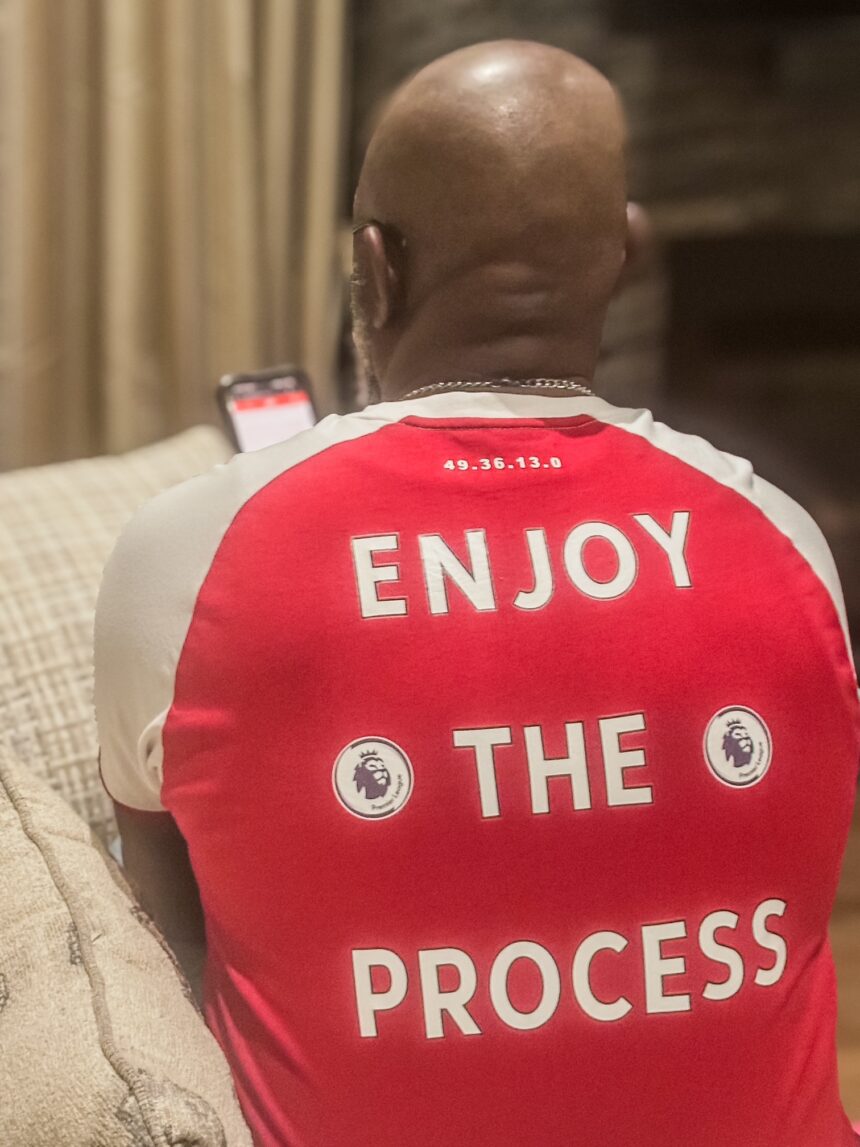
When Arteta asked us to “Trust the Process,” I embraced it because the direction was clear. This season, I’ve taken it a step further: Enjoy the Process.
I’ve been fortunate to witness title-winning Arsenal sides before. Those memories are priceless. But every journey deserves to be experienced fully. We must take in the scenery, cherish the moments, and not become so fixated on the destination that we forget the present.
Enjoying the process means backing every player, embracing every challenge, and never giving up. I truly believe 2026 will be special for Arsenal. A new generation of fans—my son included—may witness their first league title. And perhaps, just perhaps, we’ll meet destiny in Budapest, Hungary in May 2026.
As William “Rolls-Royce” Saliba recently said, this team wants to win it all. The work is being done. The belief system is strong. Nothing is being taken for granted.
The emphatic victory over Unai Emery’s Aston Villa felt like a statement—but it’s only the beginning. This team is just getting started.
And me?
I’m enjoying the process.
I have no doubt—2026 will be special.
Bimboh Adekoya is a widely travelled football person.