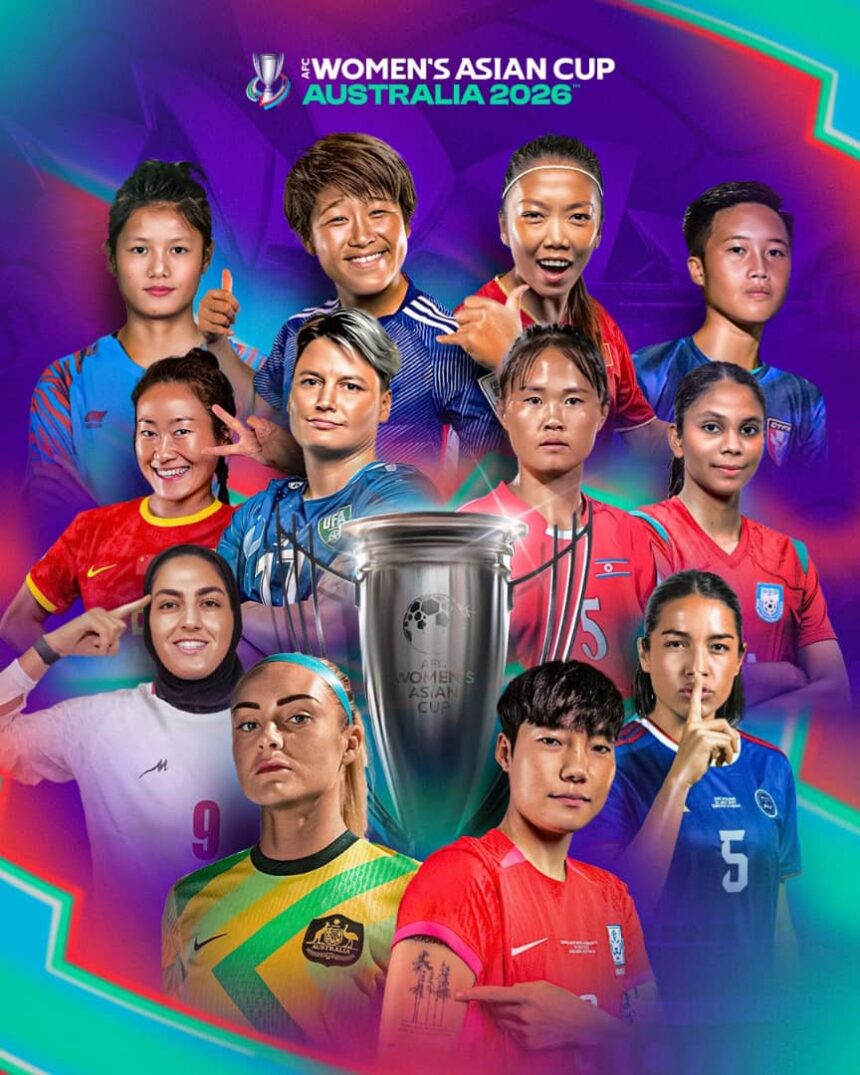

The 2026 AFC Women’s Asia Cup, hosted across Sydney, Perth and the Gold Coast from 1 to 22 March, brings three weeks of elite continental football. Beyond the quest for glory, it offers direct qualification spots for the 2027 FIFA Women’s World Cup in Brazil, raising the stakes for all twelve competing nations.
Since its inception, the competition has seen Asia’s women’s football powerhouses trade dominance. China PR has historically ruled, but Japan, Australia, and North Korea have each enjoyed their own eras of success.
Group Breakdown
Group A
Australia
The Matildas secured their only continental crown in 2010 and have the quality to end their 16-year wait for a second AFC Women’s Asian Cup trophy. Hosting for the first time since 2006, they aim to harness the momentum of their historic 2023 World Cup semi-final run and erase the disappointment of a 2022 quarter-final exit, their worst-ever finish in the competition.
South Korea
Runners-up in 2022, South Korea are still chasing a maiden Asian Cup title. Known for technical proficiency and tactical discipline, they eliminated Australia at the 2022 quarter‑final stage and they remain a perennial threat.
Philippines
A rising force in ASEAN women’s football, the Philippines reached the semi‑finals in 2022 and qualified for their first FIFA Women’s World Cup in 2023. They arrive in Australia confident and competitive, no longer mere outsiders.
Iran
Making only their second appearance at the AFC Women’s Asian Cup after debuting in 2022, Iran enter as underdogs. They secured their place in the 2026 finals with a strong qualification performance and showcased defensive resilience in their maiden campaign.
Group B
China PR (Defending Champions)
Asia’s most successful women’s team with nine titles, China PR ended a 16-year wait for continental glory with a dramatic 3–2 comeback over South Korea in the 2022 final. The defending champions head into 2026 aiming to maintain their dominance and secure back-to-back titles.
North Korea
Three-time champions (2001, 2003, 2008), North Korea are renowned for their physical intensity, tactical discipline, and strong defensive organisation. They are determined to reassert themselves as a continental powerhouse.
Uzbekistan
Returning for their sixth AFC Women’s Asian Cup appearance and their first since 2003, Uzbekistan are a developing side with long-term ambitions. Having steadily improved in recent years, they will look to make a statement in Australia and build experience ahead of hosting the 2029 edition.
Bangladesh
Making their debut in the Asian Cup, Bangladesh impressed during the qualifying campaign, demonstrating fearless attacking play. They arrive eager to compete and make history in their first continental finals.
Group C
Japan
Back-to-back champions in 2014 and 2018, Japan combine technical excellence with consistency, remaining among Asia’s elite. They have finished in the top four of every AFC Women’s Asian Cup for more than two decades and aim to continue their tradition of strong performances in 2026.
Vietnam
Making their 10th consecutive appearance, Vietnam reached the quarter-finals in 2022 and made their FIFA Women’s World Cup debut in 2023 — milestones that mark significant progress in their football history. They arrive in Australia confident and looking to build on these achievements.
Chinese Taipei
Three-time champions (1977, 1979, 1981), Chinese Taipei are in a rebuilding phase. Known for their discipline and tactical awareness, they remain a competitive side capable of causing upsets.
India
Returning after withdrawing in 2022 due to COVID-19, India, twice runners-up (1979, 1983), are seeking stability and redemption. The team will rely on its experience and attacking talent to make an impact in the 2026 tournament.
The Stakes: Road to Brazil 2027
Following a group stage of three groups of four, the top two teams from each group, along with the two best third-placed sides, will advance to the quarter-finals. All four semi-finalists will secure direct qualification for the 2027 FIFA Women’s World Cup in Brazil.
Quarter-final losers will contest play-in matches to determine which two teams qualify directly and which two enter the intercontinental FIFA Play-Off Tournament.
This edition marks the final qualification process under the current format, giving up to eight Asian nations the chance to book their passage to Brazil.
Players to Watch
- Sam Kerr (Australia) – Captain and the sole remaining member of Australia’s 2010 AFC Women’s Asian Cup-winning squad, Kerr returns after a 20-month recovery from an ACL injury. Her leadership and the precise crosses of Chelsea teammate Ellie Carpenter, enjoying a stellar season, will be vital.
- Choe Il-son (North Korea) – Reigning 2025 AFC Youth Player of the Year, Choe dominated last year with a U-20 World Cup Golden Ball and Golden Boot. She enters as one of Asia’s most feared attacking threats.
- Yui Hasegawa (Japan) – The metronome of Japan’s midfield, Hasegawa dictates play with composure and precision, orchestrating every phase of their tactical game.
- Wang Shuang (China PR) – Creative genius and the heartbeat of the defending champions. Her vision and flair, highlighted by five goals in 2022, make her indispensable.
- Manisha Kalyan (India) – India’s standout attacker and the first Indian to play in the UEFA Women’s Champions League. Her pace and directness are key for the Blue Tigresses.
- Ritu Porna Chakma (Bangladesh) – A creative attacking force whose goals helped Bangladesh reach their first AFC Women’s Asian Cup. Bangladesh will rely on her scoring threat to advance from Group B.
- Olivia McDaniel (Philippines) – A goalkeeper capable of producing match-winning performances and stealing the spotlight.
From redemption arcs to first-time dreams, from continental giants to fearless challengers, the 2026 AFC Women’s Asian Cup promises drama at every turn. For some nations, it is a chance to reclaim legacy; for others, an opportunity to rewrite history.